Your Refill Receipt Is a Dataset: How to Build a Personal Drug Price History That Pays for Itself
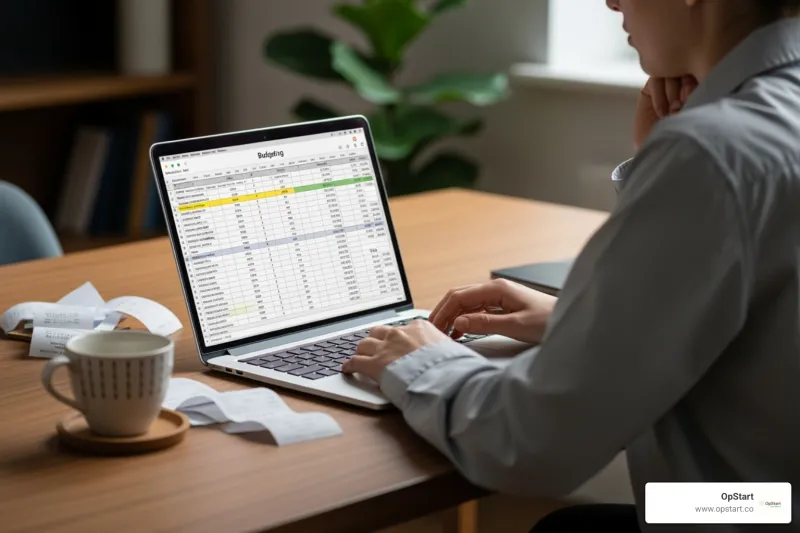
Photo: person organizing receipts and laptop spreadsheet at home desk, via images.bannerbear.com
Every refill receipt that disappears into a junk drawer is a piece of evidence you will wish you had later. Prescription prices in the United States are not stable — they drift with pharmacy pricing cycles, insurance formulary updates, deductible resets, and generic competition. The only reliable way to see those movements is to record them yourself. At RxPriceWatch, we track pricing at the market level; this guide helps you track it at the only level that affects your budget: yours.
Why Personal Price History Matters
Aggregated data tells you that drug prices vary. Your own data tells you how your specific drug, at your specific pharmacy, under your specific plan behaves over time. That distinction is worth money. Trackers who log their refills consistently report three recurring discoveries:
- Their copay for the same drug rose silently after a January formulary change
- A discount card beat their insurance copay in some months but not others
- A pharmacy across town quoted $40 less for an identical 90-day fill
None of these patterns are visible from a single receipt. All of them are visible from twelve.
The Template: Seven Columns
You need nothing more than a spreadsheet with these fields:
- Date filled — the actual transaction date, not the prescriber date
- Medication and strength — include the exact NDC from the receipt if you can find it
- Pharmacy and location — chains price by store, not just by brand
- Quantity and days' supply — 30 vs. 90 days changes unit economics dramatically
- Payment method — insurance, cash, discount card (name it), or pharmacy savings program
- Amount paid — total out of pocket, including taxes and fees
- Notes — coupon used, deductible status, anything unusual
That is it. Two minutes per refill. Set a recurring reminder tied to your refill schedule so the habit sticks.
A Worked Example
Consider a patient taking a common statin, logging refills over a year:
| Date | Pharmacy | Method | Paid |
|---|---|---|---|
| Jan 15 | Chain A | Insurance | $45 |
| Apr 10 | Chain A | Insurance | $45 |
| Jul 2 | Chain B | Discount card | $18 |
| Oct 20 | Chain B | Cash | $12 |
The July entry alone revealed a $27-per-refill gap between pharmacies. The October entry showed the cash price was $33 cheaper than the insurance copay. Over four refills, the tracker saved $120 — for a medication this cheap. Multiply across a two- or three-drug regimen and the annual figure routinely crosses $500.
Using Your Data When It Counts
A spreadsheet becomes leverage in three situations:
Negotiating with a pharmacy. Presenting a printed history showing a lower price at a competitor gives the counter staff something concrete to match. "I paid $18 here in July" is far stronger than "I feel like it used to be cheaper."
Arguing with your insurer. When a copay jumps after a formulary change, documented history supports a coverage dispute, an exception request, or a plan-switch decision during open enrollment. Insurers respond differently to evidence than to anecdotes.
Choosing at renewal. If your log shows your plan's copays exceeded available cash prices all year — meaning you got no benefit from your drug coverage — that is a decisive data point for open enrollment season.
A Word on Accuracy
Record what you paid, not the list price on the receipt. Include discount cards in your log even when they lose to insurance — the pattern of when they win is the valuable part. And back the file up; a spreadsheet that lives only on a lost phone protects no one.
Start With Your Next Refill
You do not need a year of history to begin saving — you need one comparison. At your next refill, ask for the cash price before paying, write down both numbers, and repeat. Within six months you will know things about your own prescription costs that no website, including ours, can tell you. In a pricing system this opaque, your own receipts are the most trustworthy source there is.