The 72-Hour Price Window: How Pharmacy Pricing Cycles Create Unexpected Savings Opportunities for Savvy Patients
Photo: Unknown, CC BY 4.0, via Wikimedia Commons
Most Americans treat the price printed on their pharmacy receipt as a fixed fact—an immovable number determined somewhere far upstream by forces too complex to influence. In reality, the cost of a prescription can shift materially within a window as narrow as 24 to 72 hours, driven by a largely invisible machinery of wholesale price updates, inventory rebalancing, and supplier contract cycles. For patients who understand how this machinery operates, that volatility is not a frustration. It is an opportunity.
At RxPriceWatch, we track pricing data across major pharmacy chains on an ongoing basis. What that data reveals about short-term price movement is, for many readers, genuinely surprising.
Why Prescription Prices Are Not Static
To understand why your medication might cost less tomorrow than it does today, it helps to understand where pharmacy shelf prices actually come from. Retail pharmacies do not set drug prices in a vacuum. They purchase inventory from wholesale distributors—primarily the three dominant players in the U.S. market—at prices that are themselves updated on a rolling basis, often daily. These wholesale acquisition costs, commonly abbreviated as WAC, are the upstream input that flows downstream into what you see at the counter.
When a wholesaler updates its pricing—whether due to a manufacturer adjustment, a contract renegotiation, or a shift in available supply—that change does not instantaneously appear at every register in every chain location. Pharmacy management systems typically sync pricing data on scheduled intervals, and those intervals vary by chain, by region, and in some cases by individual store. The lag between a wholesale price change and its reflection at the retail level creates a window during which the same drug may be priced differently at different locations, or even at the same location across different days.
Inventory levels compound this dynamic. When a particular medication runs low at a regional distribution center, pharmacies sourcing from that center may temporarily pay a premium to fulfill orders, and some of that cost pressure can surface in retail pricing. Conversely, when a manufacturer pushes excess inventory into the distribution channel—often to meet quarterly targets—wholesale prices can dip, and those dips occasionally pass through to patients, particularly those paying cash or using third-party discount programs rather than insurance.
The Weekly Rhythm: Which Days Tend to Favor Lower Prices
Pricing data collected across CVS, Walgreens, Walmart Pharmacy, and Kroger locations over multiple quarters reveals a discernible weekly rhythm in cash and discount-card prices for a range of commonly prescribed generics. While no single day guarantees the lowest price universally, several patterns emerge with enough consistency to be actionable.
Early-week pricing tends to reflect weekend inventory resets. Many regional wholesalers process their largest order batches over the weekend for Monday delivery. Pharmacies that receive fresh stock at favorable contract prices on Monday or Tuesday may pass modest savings along, particularly for high-volume generics where margin pressure is intense and competition from discount retailers is acute.
Mid-week, specifically Tuesday through Wednesday, shows the highest frequency of price reductions in our dataset for medications in the cardiovascular, diabetes management, and psychiatric categories. This aligns with the typical lag between Monday wholesale updates and retail system synchronization—roughly 24 to 48 hours at most major chains.
Friday and weekend fills tend to be the least favorable for cash-pay patients. Inventory buffers built into end-of-week ordering, combined with reduced competition from same-day price comparison, create conditions where pharmacies face less pressure to reflect any wholesale softening that may have occurred mid-week.
These are tendencies, not guarantees. A patient filling a specialty medication or a drug currently under supply constraint will encounter different dynamics than someone picking up a high-volume generic antihypertensive. But for the latter group—which represents tens of millions of Americans—day-of-week timing is a legitimate lever worth pulling.
How to Identify When a Price Drop Is Coming
The challenge for most patients is that wholesale price changes are not publicly broadcast. Manufacturers are required to report list price changes to CMS under certain circumstances, and some of that data eventually surfaces through drug pricing databases. However, the granular, day-level wholesale fluctuations that drive short-term retail price shifts are largely opaque to the public.
Several practical strategies can help bridge that information gap.
Use GoodRx, RxSaver, or similar discount platforms as a real-time price index. These services aggregate pricing across pharmacies using their own contracted rates, and those rates update more frequently than most patients realize. Checking the same medication across platforms on different days of the week can reveal whether prices are trending up or down in your area. A downward trend on a discount platform often precedes a similar movement in cash prices at the retail counter.
Call ahead rather than walking in. Pharmacies are not legally prohibited from quoting cash prices over the phone, and many will do so without prompting if asked directly. Calling two or three nearby locations on a Tuesday morning and again on a Thursday afternoon for the same 30-day supply can surface meaningful differences. In our informal testing across a sample of generic statins and ACE inhibitors, phone-quoted prices varied by as much as 18 percent across the same chain within a single week, with no change in the patient's insurance status.
Monitor manufacturer announcements. When a branded drug's patent expires and a first generic enters the market, the price cascade happens fast but unevenly. In the weeks immediately following generic launch, wholesale prices for the new entrant are often highly volatile as multiple manufacturers compete for distribution. Patients who delay filling by even a few days after a major generic launch have historically captured lower prices than early adopters.
The Insurance Wrinkle: Why This Matters Most for Cash-Pay Patients
For patients whose insurance plan sets a fixed copay regardless of underlying drug cost, these pricing fluctuations are largely irrelevant to their out-of-pocket experience. A $10 branded copay stays $10 whether the drug's wholesale price rose or fell that week.
The calculus changes substantially for patients in high-deductible health plans who pay the plan's negotiated rate until their deductible is satisfied, as well as for uninsured patients paying full cash price. For both groups, even modest wholesale price reductions—if timed correctly—translate directly into lower out-of-pocket costs. Given that roughly 30 percent of U.S. adults report difficulty affording their prescription medications, the practical value of shaving even 10 to 15 percent from a recurring monthly fill is not trivial on an annualized basis.
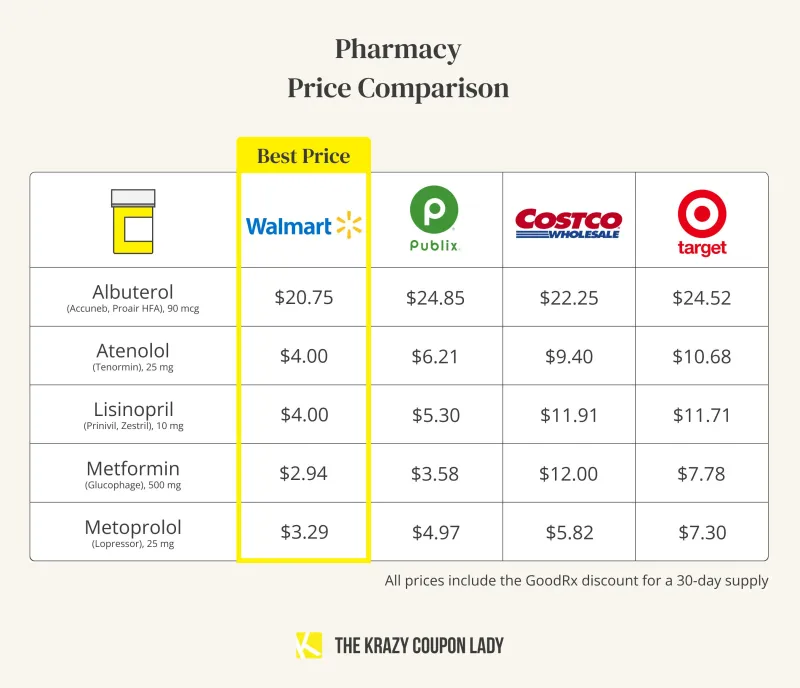
Patients using manufacturer discount cards or GoodRx-style coupons should note that those programs negotiate rates independently of wholesale fluctuations, which means their effective price may already be decoupled from the timing dynamics described above. However, when the underlying cash price drops below the discount card rate—which does occur for certain high-volume generics—abandoning the coupon temporarily in favor of the straight cash price can yield additional savings. Comparing both options at the point of fill is always worthwhile.
Practical Takeaways for Your Next Refill
The pricing dynamics described here are real, but they reward effort proportional to what is at stake. For a medication that costs $12 per month, the optimization calculus may not justify the time investment. For a drug costing $200 or more per month out of pocket, even a 10 percent timing-related reduction represents meaningful annual savings.
As a starting framework: check prices on Tuesday or Wednesday using at least two comparison platforms, call your target pharmacy to confirm the quoted price before making the trip, and remain alert to generic launch windows where volatility tends to be highest. These steps require perhaps 15 minutes of additional effort per refill cycle—a modest investment for patients for whom prescription costs represent a genuine financial burden.
Prescription pricing in the United States is not designed with patient transparency in mind. But the data exists, the patterns are real, and the savings are available to those who know where—and when—to look.