Same Pill, Wildly Different Price: How Identical Prescriptions Can Cost Five Times More Depending on Where You Fill Them
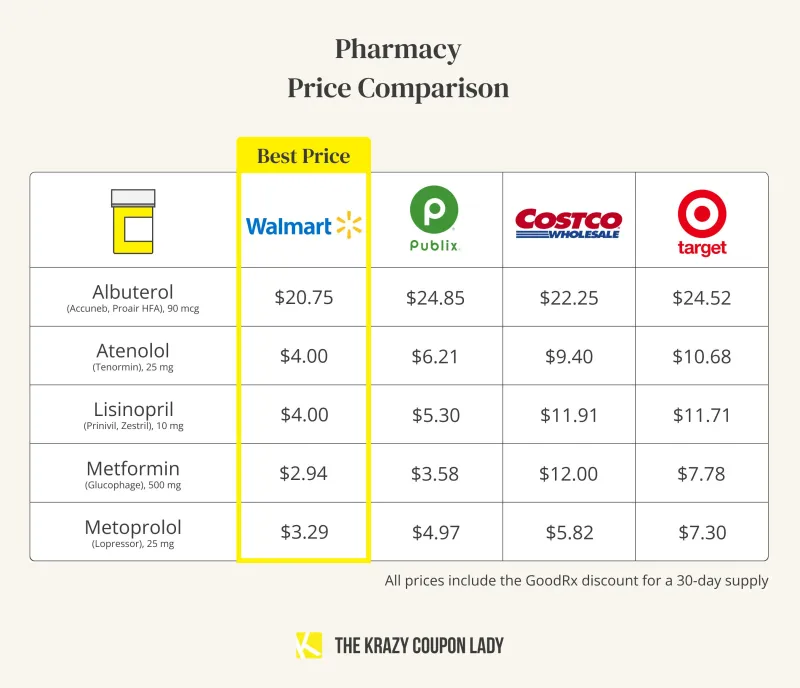
Photo: pharmacy counter price comparison prescription medication retail store, via prod-cdn-thekrazycouponlady.imgix.net
Walk into a CVS on one side of town and pay $150 for a 30-day supply of a common medication. Drive four miles to a big-box retailer and pay $28 for the exact same drug, same dosage, same quantity. This is not an anomaly — it is a routine feature of American pharmaceutical retail, and most patients never see it coming.
At RxPriceWatch, we conducted a structured price comparison exercise across independent pharmacies, regional chain pharmacies, and large-format discount retailers in three metropolitan areas — Chicago, Dallas, and Atlanta — querying cash prices for ten of the most commonly dispensed generic medications on the same business day. The results were striking. For every drug on our list, the price spread between the most expensive and least expensive pharmacy exceeded 200 percent. In two cases, it exceeded 400 percent.
This is the prescription price lottery. And the odds are not in your favor unless you know how to play.
Why Pharmacies Can Charge Such Different Prices for the Same Drug
Understanding the disparity requires a brief look at how pharmacy pricing actually works. When you pay cash — meaning you bypass your insurance entirely — the pharmacy charges what is called the usual and customary (U&C) price. That figure is set internally by each pharmacy and is not regulated by any federal or state authority. There is no ceiling, no standardized formula, and no requirement that the price bear any relationship to what the pharmacy actually paid for the drug.
Large retail chains such as CVS and Walgreens have historically maintained elevated U&C prices, in part because those figures also serve as the baseline for insurance reimbursement negotiations. Setting a high U&C price can benefit a chain in contract discussions with pharmacy benefit managers, even if the practical effect is that uninsured or underinsured patients pay far more than necessary.
Big-box retailers like Walmart and Costco operate under a fundamentally different model. Their pharmacy divisions are designed as traffic drivers — low-margin services intended to bring customers into the store. Walmart's $4 generic program, launched in 2006, permanently reset consumer expectations for what certain drugs should cost, and the retailer has maintained aggressive pricing on hundreds of generic molecules ever since.
Independent pharmacies occupy an unpredictable middle ground. Some price competitively to attract customers away from chains. Others, particularly those serving rural or underserved areas with limited competition, price at or above chain-level rates.
What Our Price Survey Found
Across our ten-drug sample — which included common medications for hypertension, cholesterol, diabetes, anxiety, and acid reflux — the average cash price at major retail chains was $87.40 for a 30-day supply. The average at big-box retailers was $19.60. Independent pharmacies averaged $54.20, though individual results varied considerably.
The most dramatic single example involved a widely prescribed generic statin. The cash price at a Walgreens location in suburban Dallas was $142 for a 30-day supply. At a Sam's Club pharmacy less than five miles away, the identical drug — same manufacturer, same strength, same count — was priced at $11. That is a difference of $131, or roughly $1,572 annualized for a patient taking the medication daily.
For a generic blood pressure medication in Chicago, the spread ran from $96 at a regional chain to $18 at a Walmart Supercenter located in the same ZIP code.
These are not edge cases. They represent the ordinary, unremarkable reality of American drug pricing — a reality that is almost entirely invisible to patients who simply hand over their insurance card at whichever pharmacy is most convenient.
The Role of Discount Programs in Complicating the Picture
The calculation becomes more complex when discount programs enter the equation. GoodRx, RxSaver, and similar platforms negotiate contracted rates with pharmacy networks that can undercut even big-box cash prices in some cases — but not consistently, and not at every location.
In our Dallas survey, a GoodRx coupon applied at the same Walgreens that had quoted $142 for the statin brought the price down to $19 — a meaningful reduction, but still $8 more than the Sam's Club cash price without any coupon at all. Meanwhile, applying a GoodRx coupon at the Sam's Club location produced a price of $9, the lowest we recorded for that drug across all channels.
The lesson is not that any single tool is always best. It is that prices are determined by the intersection of pharmacy, payment method, and discount program — and the only way to find the optimal combination is to check before you fill.
A Step-by-Step Approach to Finding the Lowest Price Before You Fill
The following process, while requiring modest effort, can produce meaningful savings — particularly for patients on maintenance medications they will take for months or years.
Step 1: Obtain your prescription details in writing. Before leaving your prescriber's office, confirm the exact drug name, strength, dosage form, and quantity. Pricing tools require this specificity to return accurate results.
Step 2: Run a simultaneous query on two or three price-comparison platforms. GoodRx, RxSaver, and Blink Health each have distinct pharmacy network contracts. Enter your drug details and ZIP code on each platform and compare the results. Do not assume that one platform consistently delivers the best price.
Step 3: Check big-box retailer cash prices directly. Walmart, Costco, and Sam's Club publish their pharmacy pricing online or via phone. These prices are often not listed on third-party comparison platforms, or are listed inaccurately. A direct call to the pharmacy takes less than two minutes.
Step 4: Call at least one independent pharmacy in your area. Ask for the cash price without mentioning insurance or coupons. Independent pharmacies frequently have discretion to match or beat competitor prices if asked directly.
Step 5: Factor in practical considerations. The cheapest price is not always the right answer. Travel time, pharmacy hours, medication synchronization with other prescriptions, and the value of an established pharmacist relationship are legitimate variables. A $12 savings may not justify a 20-minute detour. A $130 savings almost certainly does.
Why This Problem Persists — and What Would Change It
The persistence of extreme price variation is not accidental. It is structurally embedded in a system that benefits from opacity. Pharmacy chains have little incentive to advertise that a competitor sells the same drug for a fraction of the price. Insurance plans often steer patients toward in-network pharmacies that may not be the cheapest option. And the complexity of coupon programs, tiered pricing, and benefit design ensures that most patients simply default to whatever they paid last time.
Transparency legislation has made incremental progress. Several states now require pharmacies to disclose cash prices upon request, and the federal government has pushed for improved price transparency tools through CMS. But these measures remain fragmented and inconsistently enforced.
Until a more systematic solution emerges, the most reliable protection available to patients is information. Knowing that prices vary dramatically — and taking ten minutes to verify the lowest available option before filling — is a straightforward, repeatable strategy that requires no policy change, no prescription modification, and no negotiation with an insurance company.
The prescription price lottery is real. But unlike most lotteries, this one rewards preparation over chance.